Jan 12th, 2026
By Satish Reddy | Reading time 7 mins
The Hidden Ceiling: Why Your “Free” CRM Might Be Costing You More Than You Think
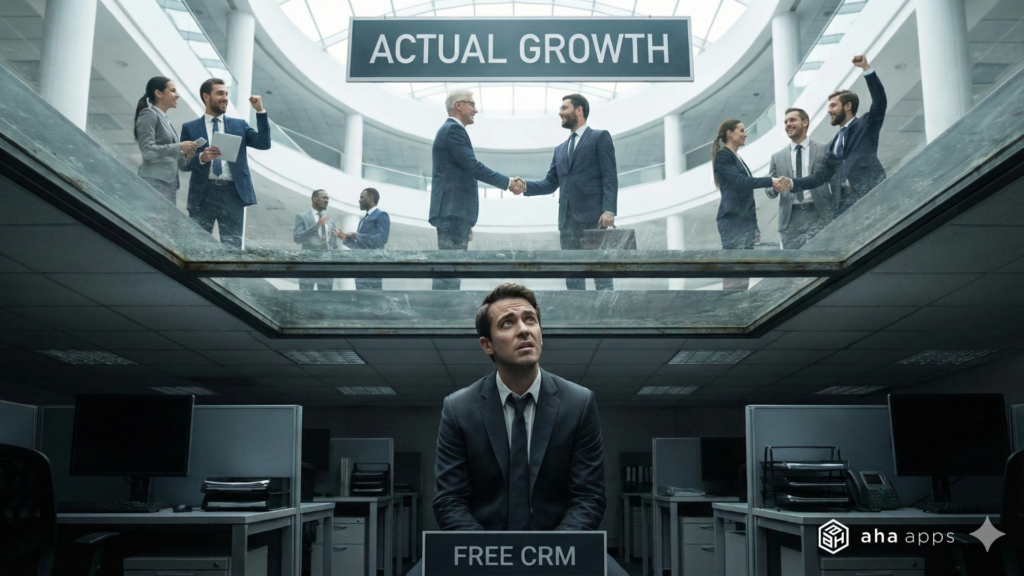
Remember the day you signed up for that free CRM?
It felt like a massive win. You were a scrappy startup nonprofit, watching every penny, and finding a tool like HubSpot Free, Airtable, or the entry-level Salesforce NPSP felt like striking gold. It organized your messy spreadsheets. It gave you a sense of control. For a while, it was exactly what you needed.
But recently, something has shifted.
Instead of feeling supported, you feel contained. You’re spending your weekends manually reconciling event data because your free CRM lacks event modules. You’re hesitant to launch that new volunteer drive because you’re terrified of hitting record limits.
Take The 5-Minute Donor Churn Diagnostic.
The tool that once liberated you is now the very thing holding you back.
If you are a nonprofit leader feeling the friction of free CRM limitations for nonprofits, this post is for you. We’re going to explore exactly why those “free” tools eventually break, the hidden costs of staying too long, and how to break through that ceiling to scale your impact.
The “Free” Trap: When Savings become Expenses
In the nonprofit world, we are conditioned to cheer for low overhead. But there is a distinct difference between being frugal and being limited.
Most free CRMs operate on a “freemium” model. They are fantastic entry points, but they are designed with deliberate nonprofit CRM feature gaps (free version). They act as a container that fits your organization when you are small, but the moment you try to stretch to grow your donor base, launch a recurring giving campaign, or manage volunteers you hit a hard wall.
Here is the reality of what scaling a nonprofit donor database when using a free CRM actually looks like.
1. The Data Cap Nightmare
Imagine this: You run a successful awareness campaign. Hundreds of new potential donors sign up for your newsletter. It should be a moment of celebration.
Instead, you receive a notification: “You have reached your record limit. Please upgrade to continue.”
Suddenly, your success is penalized. Free CRM record limits for nonprofits are the silent killers of growth. You are forced to make impossible choices: Do I delete these old volunteers to make room for new donors? Do I keep my list small just to stay free?
Growth should be celebrated, not capped.
Do you spend time on figuring out the tool or fundraising? How much support do you need to use these free tools and do you even get any support other than reading up their online documentation. Do you really have the time for this?
2. The Support Vacuum: Troubleshooting vs. Fundraising
Ask yourself honestly: Do you spend more time figuring out the tool or actually fundraising?
Free tools often come with a significant hidden cost: the lack of human support. When a report breaks or an integration fails right before your year-end campaign, who do you call? With most free CRMs, the answer is “no one.” You are left scouring online forums, reading dense documentation, or watching hours of YouTube tutorials just to send a simple email.
The challenges nonprofits face with CRM data limits are compounded by this isolation. How much support do you need to use these free tools, and do you even get any? Other than reading up on their online documentation, you are on your own.
Do you really have the time for this? Every hour you spend troubleshooting technical issues is an hour stolen from your mission. It is an hour not spent meeting a major donor, planning a program, or supporting your team. Free software becomes expensive the moment it turns your Executive Director into a part-time IT support specialist.
3. The Volunteer Disconnect
Your volunteers are often your best future donors. But where does their data live?
If you are using a generic free tool, you likely suffer from a lack of volunteer management in free CRM platforms. You might have donor data in your CRM, but volunteer schedules in Excel and event registrations in Eventbrite.
Because the free CRM lacks event/volunteer modules, you have no “360-degree view” of your supporters. You can’t see that Sarah, who just volunteered 50 hours, also has a high capacity to give. You miss the opportunity to deepen that relationship because your system sees her as two different people or doesn’t see her volunteer value at all.
The Real Cost: Human Burnout
The most dangerous cost of these limitations isn’t the software upgrade fee you’re trying to avoid. It’s your time.
When you face free CRM automation limits for nonprofits, your staff picks up the slack.
- They manually type data from one system to another.
- They spend hours cleaning up duplicates.
- They personally email receipts because the system won’t do it automatically.
This is why free CRMs don’t work for growing nonprofits. They trade money for human capital. And in a sector already facing high burnout rates, spending your team’s precious energy on data entry rather than donor connection is a trade you cannot afford to make.
When to Move from Free CRM to Paid for Nonprofits?
How do you know it’s time to migrate?
It isn’t just about the number of contacts you have. It’s about the complexity of your operations. If you find yourself saying “no” to new initiatives like a peer-to-peer fundraiser or a volunteer gala simply because your database can’t handle the logistics, you have outgrown your tool.
Paid vs free CRM for nonprofits is a conversation about investment. A paid solution isn’t a cost; it’s a growth engine.
Enter Aha Impact: Built for Growth, Not Limits
At Aha Impact, we saw these CRM scalability issues for NGOs and nonprofits and decided to build something different. We know that free CRM is insufficient for donor/volunteer growth, so we designed a solution that scales with you.
Here is how we solve the problems that are keeping you up at night:
- No Per-Record Pricing: We hate the idea of punishing you for success. Add your donors, volunteers, and prospects. Our pricing is tied to your team size, not your list size so you’re never penalized for growing your community.
- Unified Management: Stop toggling between tabs. Aha Impact combines donor management, volunteer coordination, and event planning into one unified platform. You see the whole picture of every supporter.
- Automated Stewardship: From lapsed donor tracking to automated birthday emails, we handle the routine tasks so you can focus on the relationships.
- Rapid Launch: We know you don’t have months to waste on implementation. Our “5-Day Go-Live” ensures you are up and running fast, with zero-hassle migration included.
Stop Shrinking to Fit Your Software
You have a big mission. You need a system that supports that vision, not one that constricts it.
The disadvantages of free CRM for nonprofits eventually outweigh the savings. Don’t let a “free” tool cost you your future. It is time to step into a system that values your time, respects your data, and encourages your growth.
Ready to break through the ceiling?
Stop wrestling with spreadsheets and start building relationships. Schedule a personalized 20-minute demo of Aha Impact today and see how we can give you your hours back.
The Hidden Cost of “Free” Fundraising Platforms for Nonprofits: Is Your Donor Trust at Risk?
Imagine waking up to find your nonprofit has a brand-new donation page live on the internet. Your name, your mission – it’s all there on a major fundraising site.
Except you never created it. You never gave permission.