Jun 23rd, 2026
By Satish Reddy | Reading time 9 mins
Best Nonprofit CRM Software: How Small and Mid-Sized Nonprofits Can Choose the Right Platform
Some nonprofit leaders do not realize their CRM is holding them back until a donor quietly disappears.
A long-time supporter stops giving. A volunteer attends every event but never gets invited into the donor journey. A board member asks for a simple report, and the development team spends half a day piecing it together from spreadsheets, email tools, donation exports, and memory.
That is usually the moment the real question appears: Do we actually know our supporters, or are we just storing their names somewhere?
Choosing the best nonprofit CRM software is not about buying a bigger database. For small and mid-sized nonprofits in the United States, it is about protecting relationships, saving staff time, and giving fundraising teams the clarity they need to grow sustainable revenue.
And the timing matters. Giving USA reported that charitable giving in the U.S. reached an estimated $592.5 billion in 2024, a record in current dollars, but fundraising growth does not automatically reach every organization equally. At the same time, Fundraising Effectiveness Project data has continued to show pressure on donor counts, with recent reporting noting fewer donors even when total dollars improve. For smaller nonprofits, that means donor retention, personalization, and timely follow-up are no longer “nice to have.” They are survival disciplines.
Download The Proven CRM Migration Checklist for Nonprofits
What Nonprofit CRM Software Should Really Do
At its simplest, nonprofit CRM software helps organizations manage relationships with donors, volunteers, prospects, sponsors, event attendees, board members, and community supporters. But the best systems go further. They connect giving history, engagement, communications, volunteer activity, event participation, pledges, recurring donations, and follow-up tasks in one place.
That is why nonprofits often search for related terms like donor management software for nonprofits, nonprofit donor database software, nonprofit contact management software, donor tracking software, fundraising CRM software, charity CRM software, and nonprofit database software. These are not just software categories. They reflect the same underlying pain: nonprofit teams need a clearer way to understand who their supporters are, what they care about, and when to reach out.
For a small nonprofit in Texas, Pennsylvania, Virginia, or California, this could mean knowing which donors gave last year but not this year. For a community health nonprofit, it might mean identifying volunteers who have strong engagement but no giving history. For an arts organization, it could mean seeing which event attendees are ready for a membership or recurring gift invitation.
The best nonprofit constituent relationship management software should help staff move from scattered data to confident action.
Why This Decision Is Harder for Small and Mid-Sized Nonprofits
Large organizations may have dedicated database managers, operations teams, and consultants. Small and mid-sized nonprofits usually do not. The executive director may also be reviewing donor lists. The development manager may be writing appeals, preparing board reports, checking donation forms, and managing events in the same week.
The National Council of Nonprofits has documented how workforce shortages affect nonprofits’ ability to deliver services, with staffing challenges creating real consequences for communities. When teams are already stretched, a complicated CRM can become another burden instead of a solution.
That is why the best CRM for nonprofits is not always the platform with the longest feature list. It is the one your team will actually use. If staff cannot quickly find donor history, create a segment, assign a follow-up, or run a lapsed donor report, the system will fail quietly. People will return to spreadsheets, notes, and side documents.
Before choosing a platform, ask yourself three uncomfortable questions:
- How many donor opportunities are we missing because our data is split across tools?
- If our best fundraiser left tomorrow, would their relationship history live in the CRM or only in their head?
- Are we using technology to deepen relationships, or simply to record transactions after they happen?
These questions matter because CRM selection is not just an IT project. It is a fundraising strategy decision.
The Features That Separate the Best Nonprofit CRM Platforms
The strongest best nonprofit CRM platforms help nonprofits centralize information, prioritize outreach, and reduce manual work. A good CRM should make everyday fundraising easier, not just produce attractive dashboards during a demo.
A modern CRM for fundraising teams should include complete donor profiles, gift history, recurring donation tracking, pledge management, segmentation, task reminders, donor engagement reporting, email integration, and useful dashboards. It should also help teams identify lapsed donors, first-time donors, major donor prospects, volunteers who have not donated, and event attendees who show interest but have not yet made a gift.
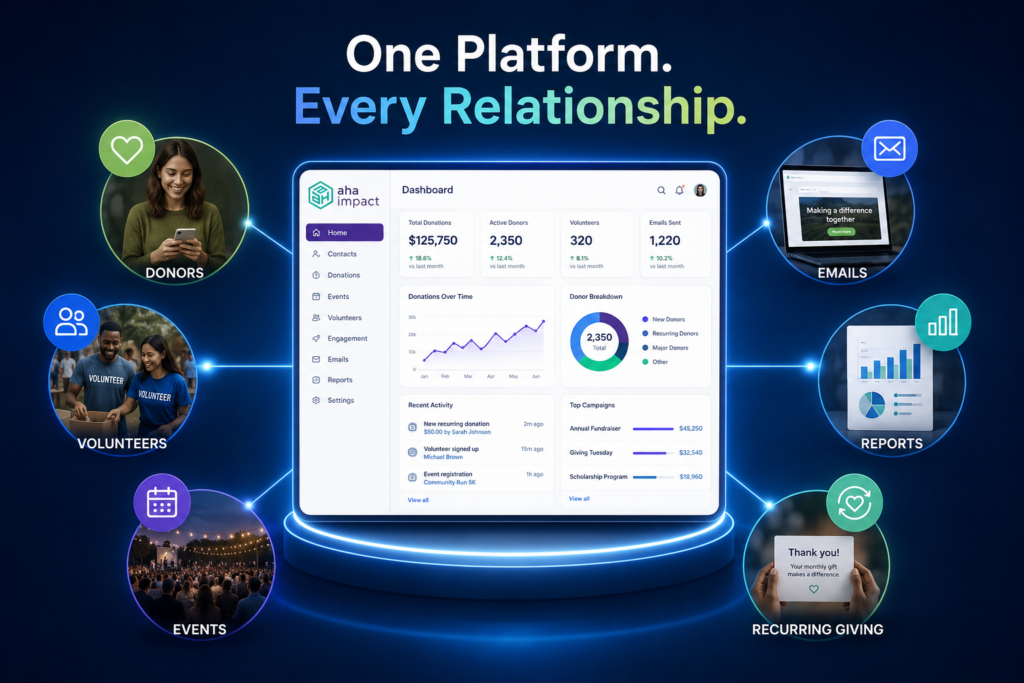
This is where Aha Impact’s product direction is especially relevant for growing nonprofits. Aha Impact is designed to show detailed donor profiles, including giving history, planned giving information, event attendance, volunteer activities, email engagement metrics, and donor journey stages such as solicitation, acknowledgement, and stewardship. That kind of visibility helps a fundraiser understand the full relationship before making the next ask.
Aha Impact also includes predefined reports for lapsed donors, consistent donors, major contributors, fresh supporters, reduced and elevated giving, single-time donors, recurring donors, and donors needing attention. For a lean team, these reports can turn a vague concern “We should check on donors who have gone quiet” into a focused action list.
Equally important, Aha Impact helps surface non-donor volunteers and event participants. Its advanced search can combine giving history with engagement signals, such as email clicks or campaign interaction, to identify people who may be ready for outreach. That matters because many nonprofits already have warm prospects inside their community. They simply cannot see them clearly because donor, volunteer, event, and email data live in separate places.
Do Not Ignore the Donor Experience
The donor’s experience with your technology matters too. A clean, branded donation page can make giving feel natural. A confusing one can create hesitation at the worst possible moment.
Strong CRM software for nonprofits should support one-time donations, recurring gifts, donor-covered fees, secure payment processing, receipts, and donor self-service where appropriate. Aha Impact includes customizable donation pages, Stripe and Google Pay integration, donor fee coverage options, secure online payments, and a donor portal where supporters can view donation history, download receipts, and manage recurring donations.
This is more than convenience. Recurring giving, clear receipts, and easy donor access all support trust. When supporters feel that an organization is organized and responsive, they are more likely to stay connected.
Pricing Should Not Punish Growth
Many nonprofits worry about outgrowing their CRM. Some systems become more expensive as contact records increase, which can create an odd penalty for building a larger community.
Aha Impact addresses this with No Per-Record Pricing. Add your donors, volunteers, and prospects. Pricing is tied to your team size, not your list size so you are never penalized for growing your community. Its pricing materials show packages for Donor + Volunteer, Donor + Event, and Donor + Volunteer + Event, with per-user monthly pricing billed annually and eligibility for 501(c)(3) nonprofits.
For small and mid-sized nonprofits, predictable pricing is not just a budget preference. It affects planning. If your team is afraid to add contacts because of future cost jumps, your CRM is working against your growth strategy.
How to Choose the Best Nonprofit CRM Software
Start with the outcomes you need, not the features vendors promote. If your biggest issue is lapsed donors, make sure the CRM can identify and segment them quickly. If your team is buried in manual work, test the reporting, dashboards, imports, and task workflows. If volunteer-to-donor conversion matters, confirm that volunteer and donor activity can be seen together.
During demos, ask vendors to show real nonprofit scenarios. Ask them to find donors who gave last year but not this year. Ask them to identify volunteers who have not donated. Ask them to pull a list of recurring donors. Ask them to show a donor’s full timeline, including gifts, emails, notes, activities, and event participation.
Also review integrations carefully. Aha Impact supports Mailchimp and Constant Contact integrations, task tracking, automated follow-up tasks, role-based dashboards, and data import capabilities. For many nonprofits, these practical workflow details will matter more than abstract promises about “engagement.”
Finally, involve the people who will use the system every week. A CRM chosen only by leadership may look good on paper but fail in daily use. Fundraisers, operations staff, volunteer coordinators, and executive directors should all be able to see how the platform helps them do their jobs better.
Conclusion: The Best CRM Helps You Remember People Better
The best nonprofit CRM software is not the one that simply stores the most information. It is the one that helps your nonprofit act on that information with care, speed, and confidence.
For small and mid-sized nonprofits in the U.S., the right nonprofit relationship management software can help reduce manual work, reconnect with lapsed donors, identify new prospects, improve donor stewardship, and bring fundraising, volunteer, and event data into one shared view. In a sector where staff time is limited and donor attention is harder to earn, that clarity is invaluable.
Aha Impact is built for growing nonprofits that want connected donor, volunteer, and event management, actionable dashboards, predefined fundraising reports, donor portals, custom donation pages, and No Per-Record Pricing.
When your team can finally see the full supporter journey, the work changes. Follow-ups become more timely. Reports become easier. Donor conversations become more personal. And your nonprofit can spend less time fighting systems and more time growing impact.
Top CRM For Nonprofit Trends You Need to Know in 2026
As we look toward 2026, the nonprofit sector is hitting a breaking point. The old way of doing things patching together “free” tools and hoping for the best is no longer sustainable.
Why? Because donor expectations have changed.